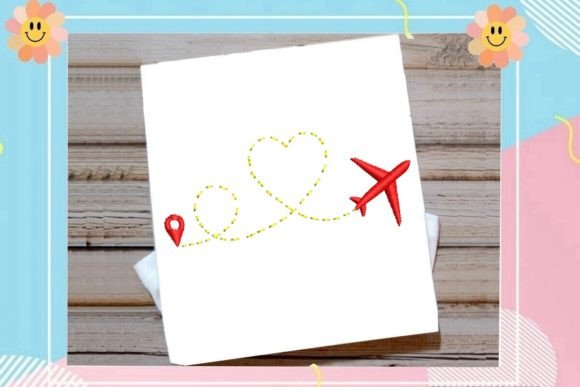
Airplane Tracing a Lovely Heart
A First Impression That Balances Whimsy and Professionalism
As an embroidery designer who’s digitized over 2,000 commercial designs for small businesses—from artisanal bakeries to boutique travel studios—I immediately recognized Airplane Tracing a Lovely Heart as more than just a decorative motif. The title alone evokes warmth, movement, and emotional resonance: a travel-themed machine embroidery design that doesn’t shout “jet set” but instead whispers connection, journey, and care. It feels friendly yet intentional—playful enough for a handmade pet brand’s tote bag, elegant enough for a florist’s apron embroidery or a café’s staff cap. It leans into the Transportation category without leaning too hard on cliché; no propellers, no runway stripes—just clean line work, balanced negative space, and symbolic harmony between motion (airplane) and meaning (heart).
Real-World Performance Across Small Business Merchandise
Airplane Tracing a Lovely Heart excels where many travel-themed embroidery files falter: versatility in scale and context. As an embroidered patch, it holds integrity at 2.5"–3.5" sizes—ideal for sew-on branding on denim jackets, reusable tote bags, or boutique product packaging. On staff uniforms—think linen aprons for a coastal bakery or cotton-blend tees for a creative studio—it reads clearly at chest level without overwhelming the garment. For cap embroidery, position it cleanly on the front panel or subtly on the side gusset; its open silhouette avoids the density pitfalls that cause puckering on curved surfaces.
Where it truly shines is in cohesive brand storytelling. A local florist could pair Airplane Tracing a Lovely Heart with hand-lettered tags reading “Locally Grown, Globally Loved.” A pet wellness brand might use it on custom apparel for adoption events—evoking both care and the idea of bringing beloved companions home. Even Etsy sellers benefit: this digital embroidery file integrates seamlessly into printable mockups for listings, lending authenticity to handmade product photography without requiring complex layering or vector overlays.
Smart Placement—and Where to Proceed With Care
Like any strong machine embroidery design, Airplane Tracing a Lovely Heart rewards thoughtful application—and reveals limitations when rushed. Avoid using it below 2" as an embroidered patch: fine tracing lines may collapse or lose definition, especially on textured fabric like canvas or twill. Cap fronts demand extra attention—test stitch-out on real fabric with proper stabilizer to ensure the heart’s curve doesn’t distort on the dome. Dark uniforms? Confirm thread colors deliver sufficient contrast; matte black thread on navy twill can mute the design’s charm unless paired with a bright accent (like cherry red or sky blue) for the heart outline.
High stitch density isn’t flagged in the description—but if the airplane’s wing detail or heart contour includes tight satin stitches, review spacing carefully before scaling down. Overly dense areas risk stiffness on soft fabrics like lightweight cotton or rayon blends used in boutique merchandise. And always test on the *actual* fabric—not just stabilizer swatches. A design that looks crisp on polyester poplin may feather on organic linen unless you adjust underlay or reduce density manually.
Why This Design Strengthens Brand Identity
In small business merch, consistency builds trust. Airplane Tracing a Lovely Heart supports visual continuity across touchpoints: a single design asset used on staff caps, customer gift totes, and product hangtags tells a unified story—without needing a full logo suite. It signals approachability and intentionality, reinforcing values like care, exploration, and personal connection. Customers don’t just see an airplane and a heart; they feel the narrative behind your brand. That emotional resonance lifts perceived value—especially for handmade products where buyers seek meaning, not just utility.
For crafters and digital embroidery file buyers, this design also serves as a reliable anchor in a broader collection. Pair it with minimalist typography or subtle botanical motifs, and you’ve built a scalable design system. Unlike overly literal transportation icons, Airplane Tracing a Lovely Heart avoids dating quickly—it won’t feel out of place in 2026 or 2030, supporting long-term brand recognition.
Practical Embroidery Designer Notes for Commercial Use
- Always test in black and white first—to assess line weight, spacing, and balance before committing to thread colors.
- Verify patch-size viability: run a 2.25" version on scrap fabric with your intended stabilizer stack.
- Review thread color contrast on both light and dark substrates—especially for small business merch meant for diverse uniforms.
- Inspect spacing between airplane and heart elements: tight gaps may fill in during stitching; adjust if needed for clarity at smaller scales.
- Confirm hoop size compatibility with your production workflow—some versions may require larger hoops than standard cap frames.
- Test on real fabric, not just stabilizer—texture dramatically affects how satin stitches lay and how outlines register.
- Use cutaway or tear-away stabilizer appropriately: lightweight cutaway for knits, medium-weight tear-away for stable wovens like canvas or denim.
- Create a printable mockup for client approval—this avoids misalignment surprises and strengthens your professional credibility.
- Compare Airplane Tracing a Lovely Heart beside other design assets in your brand kit to ensure tonal harmony and visual hierarchy.
- Confirm commercial licensing before any production run—this is non-negotiable for small business merch, custom apparel, or resale items.
Remember: the strength of Airplane Tracing a Lovely Heart lies not in complexity, but in considered simplicity. It’s a rare travel-themed machine embroidery design that serves function *and* feeling—making it a smart, sustainable choice for embroidery shops, apparel decorators, and small business owners building something memorable, one stitch at a time.